What are Randomly.online's converter tools?
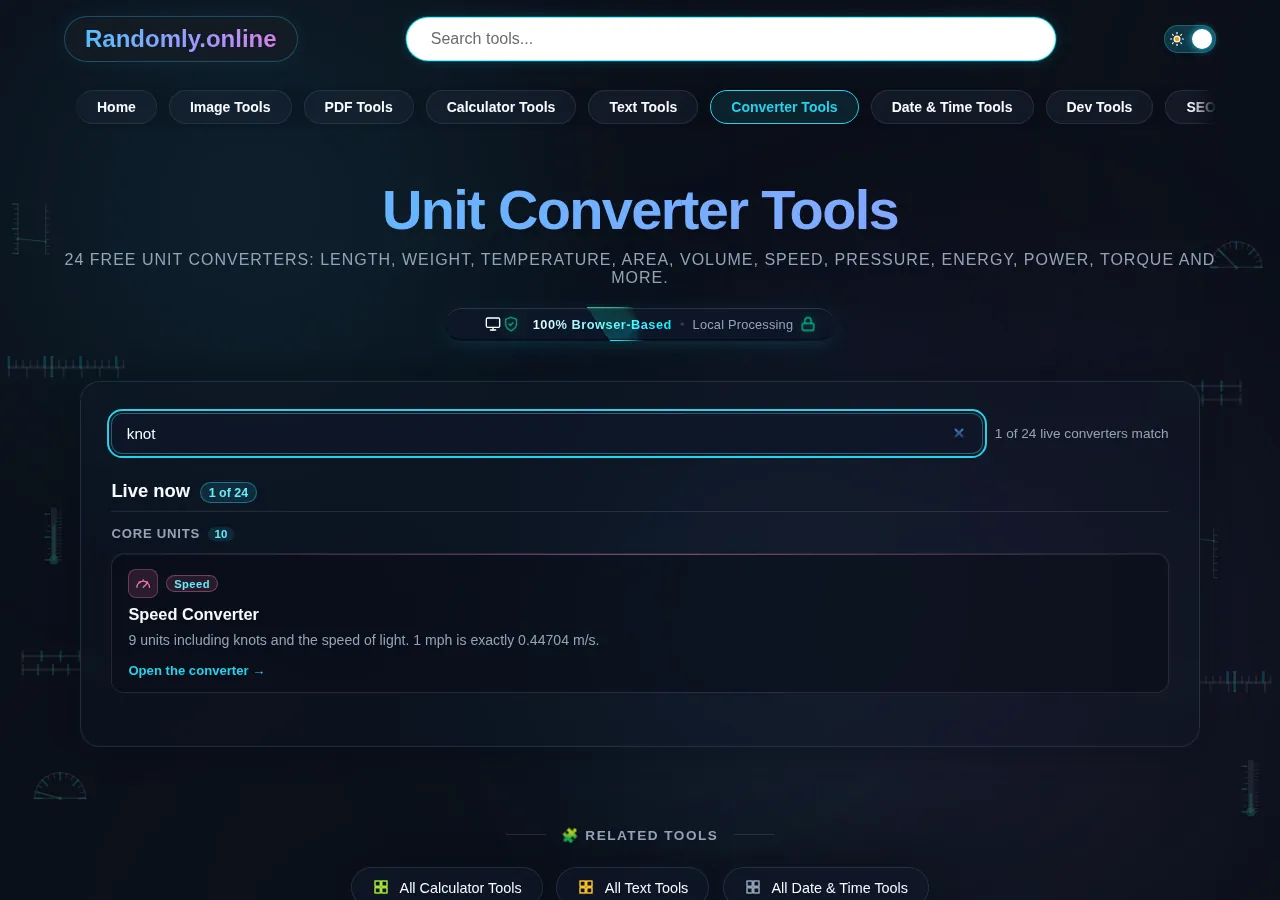
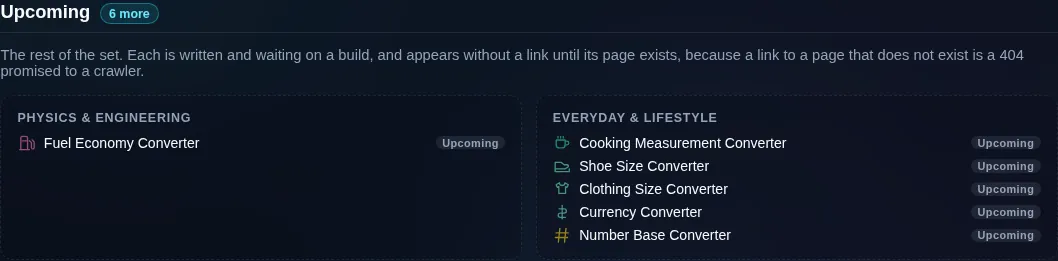
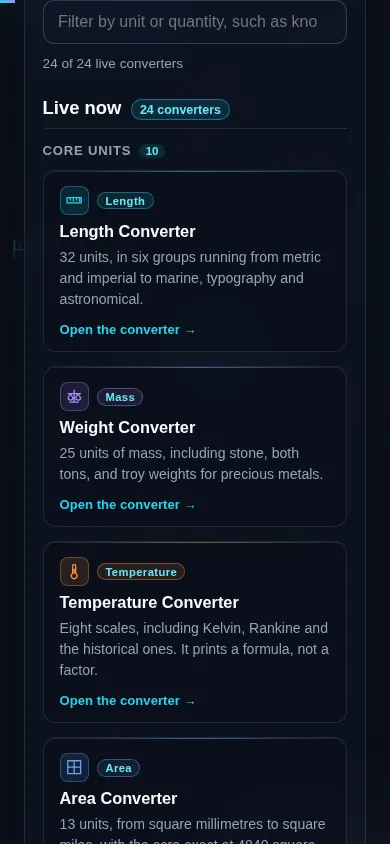
Randomly.online's converter tools turn one unit into another in your browser, free and without a signup. Twenty-seven are live, covering length, weight, temperature, area, volume, speed, time, data storage, pressure, energy, power, force, density, frequency, torque, flow rate, acceleration, angle and fuel economy, plus number bases and cooking measures. Each prints the exact relation behind its answer. Nothing you type is uploaded.
### H2: How these converters work
A conversion is only as good as the number it multiplies by. They do not store one. Every unit is held as a whole number of atoms instead: picometres for length, nanograms for mass, bits for data, microseconds for time. Converting is then one multiply and one divide, both by exact integers, which is why 100 cm turned into inches and back is still 100 cm rather than 100.0001. The factor printed under each answer comes from that same table, so it cannot drift from the arithmetic above it.
It also lets the tools be honest about the conversions that are not exact. One inch is 2.54 centimetres exactly, so that direction terminates. The reverse does not. 0.393700787… repeats forever, and a converter that prints a rounded figure and calls it exact is doing the one thing this category exists not to do. So a unit is described as exact only when its size really is a whole, safe number of atoms. The US survey foot is 1200/3937 of a metre and never qualifies. Neither does a light year, which is defined exactly but sits far past the largest integer JavaScript can hold without losing digits.
The size of that atom decides which units can exist at all, and each quantity is a different argument. A cup is a gallon over sixteen, so it is never a whole number of nanolitres, and the whole cup family is marked approximate. Speed counts in eighteen-hundred-thousandths of a metre per second because a km/h is 5/18 and an mph is 0.44704, and both have to come out whole. Time cannot hold nanoseconds and centuries at once, so it starts at the microsecond. A pebibyte is 2^53 bits, one more than the largest safe integer, and it says so.
Temperature is the exception to all of it. Its scales begin at different zero points, so converting means multiplying <em>and</em> adding, which is an affine map rather than a factor. The temperature tool prints a formula where the others print a ratio. Sending it through the factor path would put 0 °C at 0 °F.