Health Calculators

Free health and fitness calculators — BMI, BMR, body fat, ideal weight, calorie needs, water intake and running pace.

100% Browser-Based Local Processing

Health & Fitness 7

Screening estimates from standard formulas, honest about what they cannot see.

More calculators

The other eight groups, and the full index of all 55.

Privacy Focused

🔒 Local Processing. Your numbers never leave your device.

Instant Results

🌐 Fully Client-Side. Runs instantly in your browser.

No Signup

⚡ No accounts. No API keys. Just open and use.

Browser Based

🚀 No installs, no sign-ups, no server round-trip.

What are the Health Calculators?

Randomly's health calculators apply standard population formulas to give screening estimates — Body Mass Index, basal metabolic rate, body fat percentage, ideal weight range, daily calorie needs, water intake and running pace. Each names the formula it uses, runs in your browser, and is a general estimate rather than medical advice.

Seven calculators built on formulas you can look up: BMI, Mifflin-St Jeor and Harris-Benedict for metabolic rate, the US Navy method for body fat, and the standard ideal-weight equations. The point of naming them is that you can check what the tool is doing and decide whether it suits you.

These formulas were derived from populations, not from you. They are screening tools — useful for spotting that something is worth looking into, poor at describing an individual. BMI famously cannot tell muscle from fat. Every page in this group says what its formula misses rather than presenting a number as a verdict.

As with everything on the site, height, weight and age are processed in your browser and never uploaded. Health figures are the last thing that should be sitting in somebody's database.
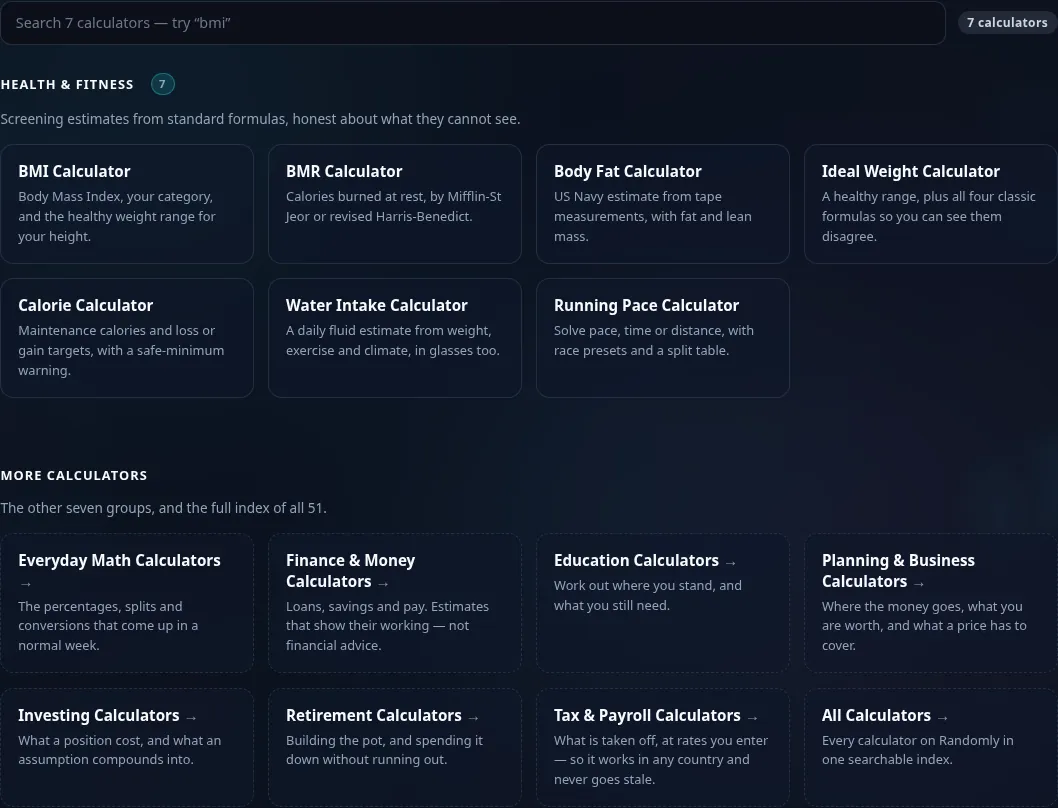
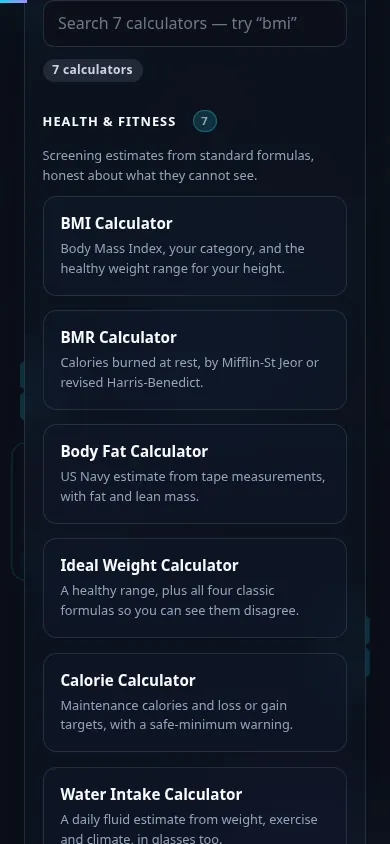
Health Calculators in action

The Health & Fitness calculator grid on Randomly in dark mode — 7 cards: BMI, BMR, Body Fat, Ideal Weight, Calorie, Water Intake, Running Pace
Tool grid (7 calculators)
The Health & Fitness calculators on a phone, the 7 cards stacked in a single column
Mobile (stacked grid)

Good to know

  • The formula is named and shown. BMI, Mifflin-St Jeor, Harris-Benedict, US Navy — you can see which method produced the number and look it up.
  • Honest about limits. Each page states what its formula cannot see: body composition, frame size, age effects, athletic build, pregnancy.
  • Metric and imperial throughout. Switch units without re-entering anything, and without the unit-conversion mistakes that silently produce a plausible wrong answer.
  • Nothing is uploaded. Height, weight, age and sex stay in your browser. No account, no storage, nothing transmitted.

Frequently Asked Questions

What health calculators are in this group?

Seven: BMI, BMR, Body Fat, Ideal Weight, Calorie, Water Intake and Running Pace. They cover body composition screening, energy requirements, hydration and training pace. Each uses a published formula that is named on the page.

Are these calculators medical advice?

No. They are general estimates produced by applying population-derived formulas to the numbers you enter. They do not know your medical history, body composition, medications or conditions, and they cannot examine you. Use them as a starting point for a conversation with a healthcare professional, not as a diagnosis or a treatment decision.

Is my height, weight and age sent anywhere?

No. Every calculation runs in your browser. Nothing you enter is transmitted, logged or stored, and it is gone when you close the tab. There is no account. Health data is exactly the kind of information that should not be sitting on a server, so it never is.

Why can BMI be misleading?

BMI is a ratio of weight to height squared. It has no way to distinguish muscle from fat, so a muscular athlete can be classified as overweight while someone with low muscle mass and high body fat can sit in the normal range. It also does not account for fat distribution, age or ethnicity, all of which affect health risk. It is a population screening tool that happens to be applied to individuals.

Which BMR formula do you use?

The BMR Calculator uses Mifflin-St Jeor by default, which is generally the more accurate of the two common equations for modern populations, and also offers Harris-Benedict for comparison. Both are shown with their substituted values so you can see the difference between them for your own figures.

How is body fat percentage estimated?

The Body Fat Calculator uses the US Navy circumference method, which estimates from height and tape measurements at the neck, waist and — for women — hips. It is far cheaper and more accessible than a DEXA scan, and correspondingly less precise. The page states the expected margin of error so you can judge it.

How many calories do I actually need?

The Calorie Calculator estimates maintenance needs by taking your BMR and multiplying by an activity factor, then adjusts for a weight goal if you set one. Activity factors are broad categories, so the result is a starting point to test against real-world results over a few weeks rather than a precise prescription.

What is a healthy weight range for my height?

The Ideal Weight Calculator gives a range rather than a single number, using the standard equations (Devine, Robinson, Miller, Hamwi) alongside the BMI-derived healthy range. They disagree with each other, which is informative — it shows that "ideal weight" is a band, not a target.

How much water should I drink a day?

The Water Intake Calculator estimates from body weight and activity level, adjusting for exercise duration and climate. It is a guideline: actual needs vary with diet, health and environment, and a good deal of daily fluid comes from food. Thirst and urine colour remain better day-to-day signals than any formula.

Can I use these if I am pregnant, a child, or an athlete?

Be careful. These formulas were derived from general adult populations, so they are least reliable for exactly those groups. BMI in particular is not interpreted the same way for children, who are assessed on age-and-sex percentiles instead. Each page flags where it does not apply, and for these cases a healthcare professional is the right source.

Do they support both metric and imperial?

Yes, throughout. You can switch units on any calculator in this group without re-entering your figures. Unit handling is the most common source of a wrong-but-plausible answer in health calculators, so conversion is done internally rather than asking you to convert first.

Are these calculators free?

Yes. Free, unlimited, no account, nothing to install, and no advertising interstitials between you and the tool.

Still have questions?

If you can't find the answer you're looking for, feel free to contact our support team.

Contact Us