Loan & Property Calculators

Free loan and property calculators — the true APR once fees are counted, how much house your income supports, whether a refinance repays its own costs, and lease against buy over the years you keep it.

100% Browser-Based Local Processing

Loans & Property 4

What a loan really costs, and what a decision about a house or a car costs over the years you keep it.

More calculators

The other eight groups, and the full index of all 55.

An estimate, not financial advice. Figures are indicative, and the assumptions behind them are stated on the tool itself. Tax rules, rates and fees vary by country and change over time — check against your provider or a qualified adviser before acting on a number.

Privacy Focused

🔒 Local Processing. Your salary and balances never leave your device.

Instant Results

🌐 Fully Client-Side. Runs instantly in your browser.

No Signup

⚡ No accounts. No API keys. Just open and use.

Browser Based

🚀 No installs, no sign-ups, no bank account linking.

What are the Loan & Property Calculators?

Randomly’s loan and property calculators work out what borrowing actually costs: the APR once fees are folded into the rate, the house price your income and existing debts support, whether a refinance ever repays its closing costs and what it does to the lifetime interest, and whether leasing or buying is cheaper over the years you keep the thing. Every figure you enter stays in your browser.

Four calculators, and what they have in common is that the number being advertised is not the number that matters. A quoted rate says nothing about the fees charged to write the loan. A monthly payment says nothing about how long you will be making it. A lease payment looks smaller than a loan payment because it buys less. In each case the comparison people are invited to make is the wrong one.

So each of these computes the figure the headline hides, and shows the arithmetic that got there. The APR calculator asks what rate turns the money you actually receive into the payments you actually make. The refinance calculator prints the lifetime interest both ways, because a lower payment over a longer term can cost more. The affordability calculator separates the payment cap from the mortgage budget, since tax and insurance are paid out of the same capped figure. The lease-versus-buy calculator nets the resale value off the buying side, which is the only way the two are comparable at all.

Income, balances and debts are among the most sensitive things anyone types into a website. None of it leaves the page: the arithmetic runs in your browser, there is no account, and nothing is stored when you close the tab.
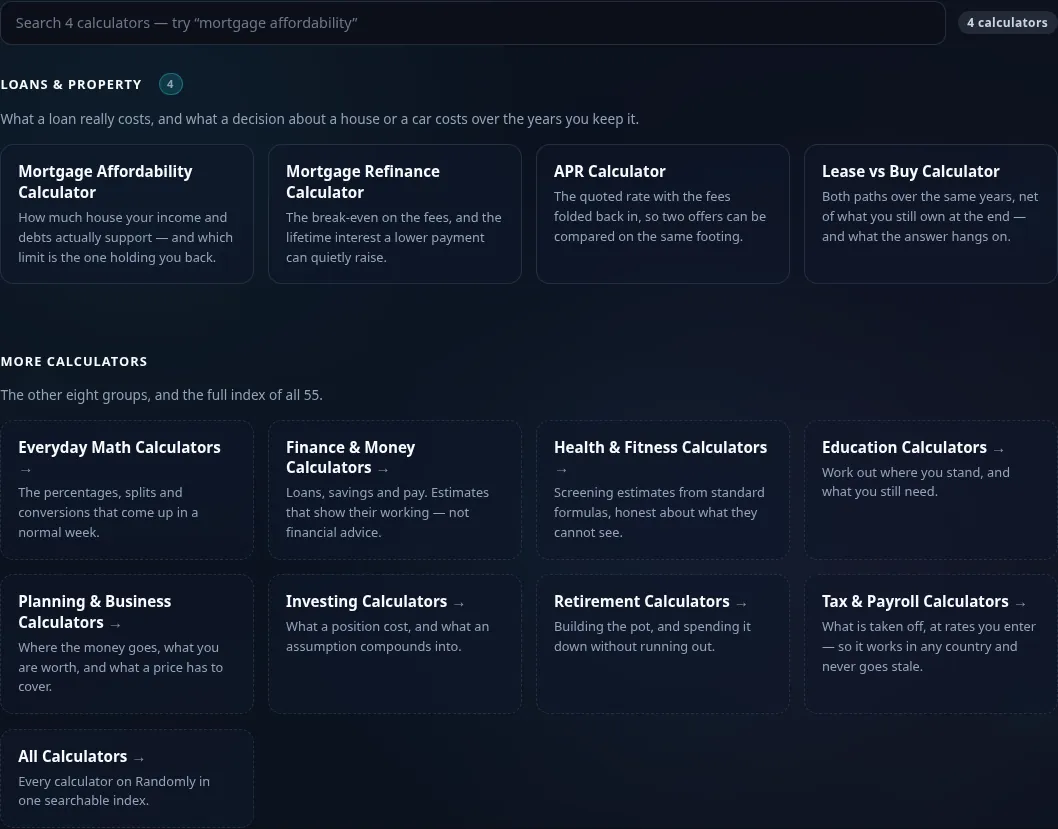
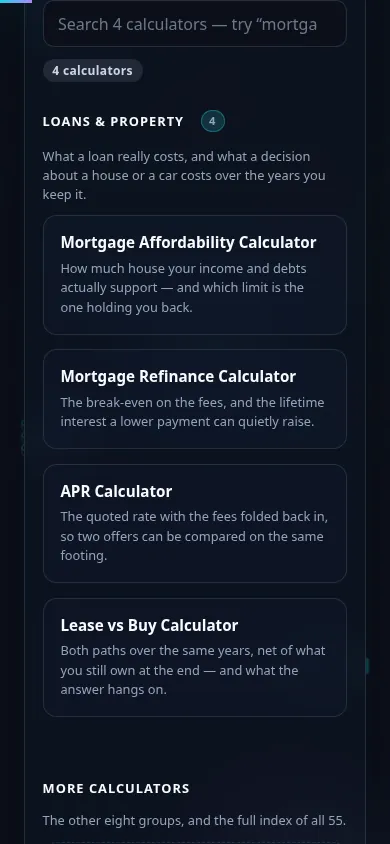
Loan & Property Calculators in action

The Loans & Property calculator grid on Randomly in dark mode — 4 cards: Mortgage Affordability, Mortgage Refinance, APR, Lease vs Buy
Tool grid (4 calculators)
The Loans & Property calculators on a phone, the 4 cards stacked in a single column
Mobile (stacked grid)

Good to know

  • The fees are in the rate, not beside it. APR is the only fair way to compare two offers, and it only works when the same fees are counted on both — which the calculator says rather than assuming.
  • A lower payment is not a saving. Refinancing a loan with 24 years left into a fresh 30 cuts the payment and can raise the total bill. The lifetime interest is printed both ways, side by side.
  • Affordability is not approval. DTI limits are lender guidelines that vary by lender, loan type and country, so both limits are fields here — and the calculator says which of them is the one actually binding.
  • The assumption is named, not buried. Lease against buy turns entirely on a guess about a resale market years away, so the calculator prints the resale value at which the two cost the same and lets you argue with that instead.

Frequently Asked Questions

What loan calculators are in this group?

Four: the APR Calculator, the Mortgage Affordability Calculator, the Mortgage Refinance Calculator and the Lease vs Buy Calculator. Between them they cover what a loan costs, how much of one you can carry, whether to replace one you already have, and whether to borrow for the thing at all.

What is the difference between an interest rate and an APR?

The interest rate is what the balance is charged. The APR is the rate at which the money you actually receive would grow into the payments you actually make — so any fee charged to write the loan is inside it, and none of it is inside the quoted rate. Two offers at the same rate are not the same offer if one charges four thousand to arrange it. With no fees at all the two figures are identical, which is the clearest demonstration that the gap is fees and nothing else.

Is APR the same as APY or EAR?

No. APR describes the cost of borrowing with fees folded in; APY and EAR describe what compounding does to a rate, usually on savings. They answer different questions and can move in opposite directions. Which fees a lender must include in an advertised APR also differs by country — US Reg Z and UK or EU representative APR do not draw the line in the same place — so an APR is a fair comparison exactly to the extent that both sides counted the same things.

How much house can I actually afford?

Lenders work from debt-to-income limits: a share of your gross income for all debt payments together, and often a tighter share for housing alone. Whatever is left after your existing debts is the housing cap — and property tax, insurance and any HOA fee come out of that same cap, so only the remainder supports a mortgage. The calculator does that in order and reports which of the two limits is binding, because if it is the housing limit then clearing a car loan will not raise your budget at all.

Does affordability mean I will be approved?

No, and it does not mean you should borrow that much either. A lender also weighs credit history, employment, savings reserves and the property itself, none of which arithmetic can see. Treat the figure as the ceiling the numbers allow, get a pre-approval for the real one, and remember that a house asks for money after you buy it.

When does refinancing a mortgage make sense?

When the monthly saving repays the closing costs before you sell or move — that is the break-even — and when the total interest over the life of the new loan, plus those costs, is not more than staying put. Those two tests can disagree. Refinancing into a longer term almost always lowers the payment and can still cost more overall, which is why the calculator shows both rather than leading with the monthly figure.

What is a no-cost refinance?

Usually a refinance where the fees are paid out of a higher rate rather than not charged. That can be the right trade if you expect to move before an ordinary break-even, but it is not free, and comparing it against a fee-paying offer on the rate alone will always flatter it. Compare on APR.

Is leasing cheaper than buying?

The monthly payment is almost always lower, and that is not the same question. A lease payment buys the use of the thing; a loan payment buys the use and a share of something you still own at the end. Once the resale value is netted off the buying side, and any balance still owed on the loan is settled out of the sale, the answer frequently reverses. The calculator does both over the same holding period so the comparison is like for like.

How much does the resale value change the answer?

Enough that it is usually the whole decision. That is why the calculator prints the resale value at which leasing and buying cost exactly the same: it turns a verdict you have to trust into a threshold you can judge. If the tie point looks like a figure the car will comfortably beat, buying wins; if it looks optimistic, it does not.

Is any of this financial advice?

No. These are arithmetic tools applying standard formulas to figures and assumptions you supply. They do not know your circumstances, your credit position, your local rules or what else you are planning to do with the money, and borrowing decisions are hard to reverse. Speak to a qualified professional before acting on any of it.

Still have questions?

If you can't find the answer you're looking for, feel free to contact our support team.

Contact Us