Planning & Business Calculators

Free planning calculators — budget your take-home pay, work out net worth, size an emergency fund, find your break-even point, and price for a margin.

100% Browser-Based Local Processing

Planning & Business 5

Where the money goes, what you are worth, and what a price has to cover.

More calculators

The other eight groups, and the full index of all 55.

An estimate, not financial advice. Figures are indicative, and the assumptions behind them are stated on the tool itself. Tax rules, rates and fees vary by country and change over time — check against your provider or a qualified adviser before acting on a number.

Privacy Focused

🔒 Local Processing. Your salary and balances never leave your device.

Instant Results

🌐 Fully Client-Side. Runs instantly in your browser.

No Signup

⚡ No accounts. No API keys. Just open and use.

Browser Based

🚀 No installs, no sign-ups, no bank account linking.

What are the Planning & Business Calculators?

Randomly’s planning calculators cover the money decisions that come before any single purchase: splitting take-home pay across needs, wants and savings, totalling net worth, sizing an emergency fund, finding the sales volume that covers costs, and setting a price that hits a margin. Each shows its formula and runs entirely in your browser.

Five calculators for the questions that sit one level above a single transaction — not what a loan costs, but whether the shape of your money works. Two are household tools, two are business tools, and net worth belongs to both.

This is the group where privacy stops being a feature and becomes the reason to use a page instead of an app. Your income, your savings, your debts and your margins are exactly what budgeting and net-worth services ask you to hand over, usually by linking a bank account. Nothing here is linked to anything: the arithmetic happens in the page, and the figures are gone when the tab closes.

They are also the group most prone to false precision, so each one is explicit about what it assumes. A 50/30/20 split is a starting framework, not a law. A property valuation is what it would sell for, not what you hope. A break-even point assumes one price and one variable cost at every volume.
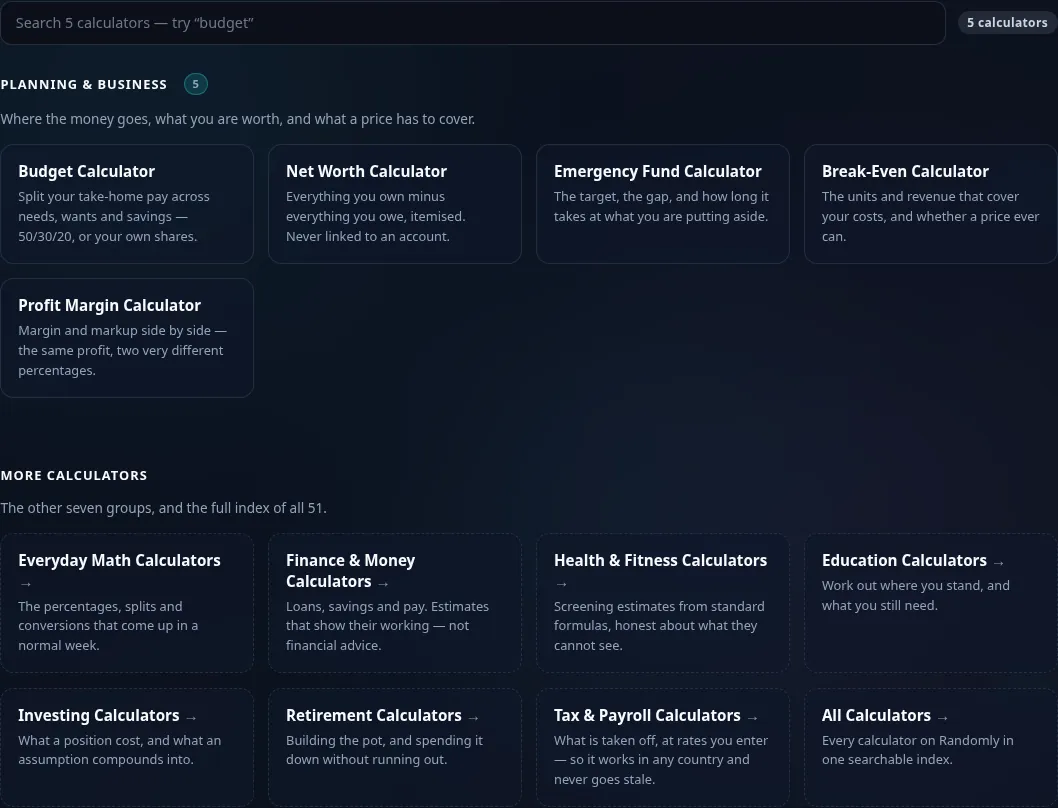
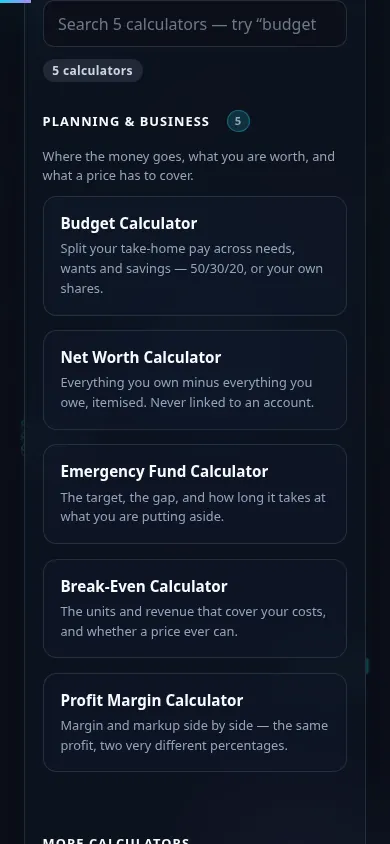
Planning & Business Calculators in action

The Planning & Business calculator grid on Randomly in dark mode — 5 cards: Budget, Net Worth, Emergency Fund, Break-Even, Profit Margin
Tool grid (5 calculators)
The Planning & Business calculators on a phone, the 5 cards stacked in a single column
Mobile (stacked grid)

Good to know

  • No account linking, ever. Budgeting and net-worth apps ask for bank access. These are ordinary web pages — nothing is uploaded, stored or associated with you.
  • The guideline is adjustable, not baked in. 50/30/20 and “three to six months” are defaults you can change, because the right answer depends on where you live and how steady the income is.
  • They answer the awkward cases honestly. A negative net worth is shown with its minus sign. A price at or below its variable cost is told plainly that no break-even exists at any volume.
  • Margin and markup are shown together. The same profit as a share of price and as a share of cost — confusing the two is the most expensive arithmetic error in small-business pricing.

Frequently Asked Questions

What planning calculators are in this group?

Five: Budget, Net Worth, Emergency Fund, Break-Even and Profit Margin. The first three are household planning — where income goes, what you are worth, and how much cover you need. The last two are business planning — the volume that covers your costs, and the price that produces the margin you want.

Should I budget on gross or take-home pay?

Take-home. Every honest version of the 50/30/20 framework is built on net income, because gross pay includes money that never reaches you. Budgeting on gross overstates every category by whatever tax and deductions take, which is why a plan built that way stops working in the second week of the month.

Is the 50/30/20 rule actually right?

It is a starting framework, not a law. It works well as a first shape for a budget, but a high-rent city can make 50% for needs arithmetically impossible, and someone clearing high-interest debt may want far more than 20% going to savings and repayment. The split is adjustable for exactly that reason, and the calculator tells you when your shares do not add up to 100% rather than quietly rescaling them.

How much should an emergency fund be?

The usual advice is three to six months of essential expenses, and that is the default here — but it is a guideline. Variable or single-household income, dependents, or a long expected job search argue for more; a very stable job with other resources to fall back on argues for less. Use essential expenses rather than normal spending: an emergency budget is leaner than ordinary life, and padding it with discretionary spending inflates the target.

Can net worth be negative?

Yes, and routinely is. Anyone with a recent mortgage, or student debt and no property, can owe more than they own. It is a stage rather than a verdict, and it moves as balances come down. The calculator shows the figure with its minus sign rather than clamping at zero, because the person who most needs the number is the one it is negative for.

Is my income or net worth uploaded anywhere?

No. All five calculators run entirely in your browser. Nothing you type is transmitted, logged or saved, and closing the tab clears it. There is no signup, so there is no account for any of it to be attached to. That is the substantive difference from budgeting and net-worth apps, which generally require linking a bank account.

What is the difference between margin and markup?

They are the same profit over a different denominator. Margin divides by the selling price; markup divides by the cost. A 50% markup is a 33.3% margin, so a business that prices for a “50% margin” by adding 50% to cost undercharges by a third. Both are shown side by side, each labelled with its denominator, rather than offered as a mode you could read the wrong way.

What if there is no break-even point?

That happens whenever the price is at or below the variable cost per unit — every extra sale then loses money, and no volume ever covers the fixed costs. The textbook formula divides by zero or by a negative and returns something that looks like an answer. The calculator says “never” instead, and states what the price would have to clear.

Do these results count as financial or business advice?

No. They are arithmetic tools that apply standard formulas to the figures you enter. They use simplified models — constant costs, a fixed split, valuations you supply — and know nothing about your wider circumstances. Use them to compare scenarios and get a sense of scale, and speak to a qualified professional before a decision that matters.

Which calculator should I start with?

For household money, start with the Budget Calculator: it sets the shape everything else fits into, and the savings share is what funds the emergency fund. For a business idea, start with Profit Margin to set a price that works per unit, then Break-Even to find the volume that price has to reach.

Still have questions?

If you can't find the answer you're looking for, feel free to contact our support team.

Contact Us