An Offset Is Only True For A Date
A UTC offset says how far a place sits from Coordinated Universal Time: New York at UTC-04:00 is four hours behind it, Kolkata at UTC+05:30 is five and a half hours ahead. The number is easy. What catches people out is that for roughly a third of the world it is not one number. Clocks move twice a year, the two hemispheres move them in opposite seasons, and the dates are set by law rather than by arithmetic, so an offset quoted with no date attached is a guess that happens to be right for part of the year.
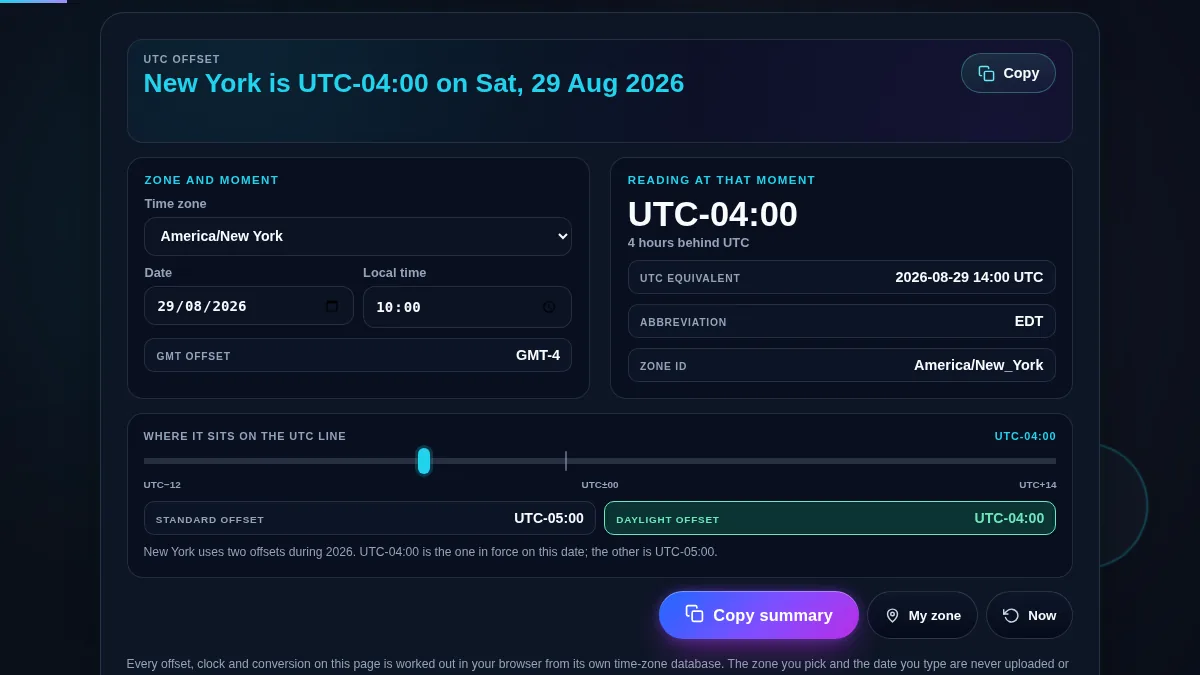
This tool asks for the date along with the zone, and reads the offset your browser's own time zone database holds for that instant. Set it to a day in July and a day in January and a European or North American zone will give you two different answers, both correct. That is the whole reason the date field is there rather than assumed to be today.
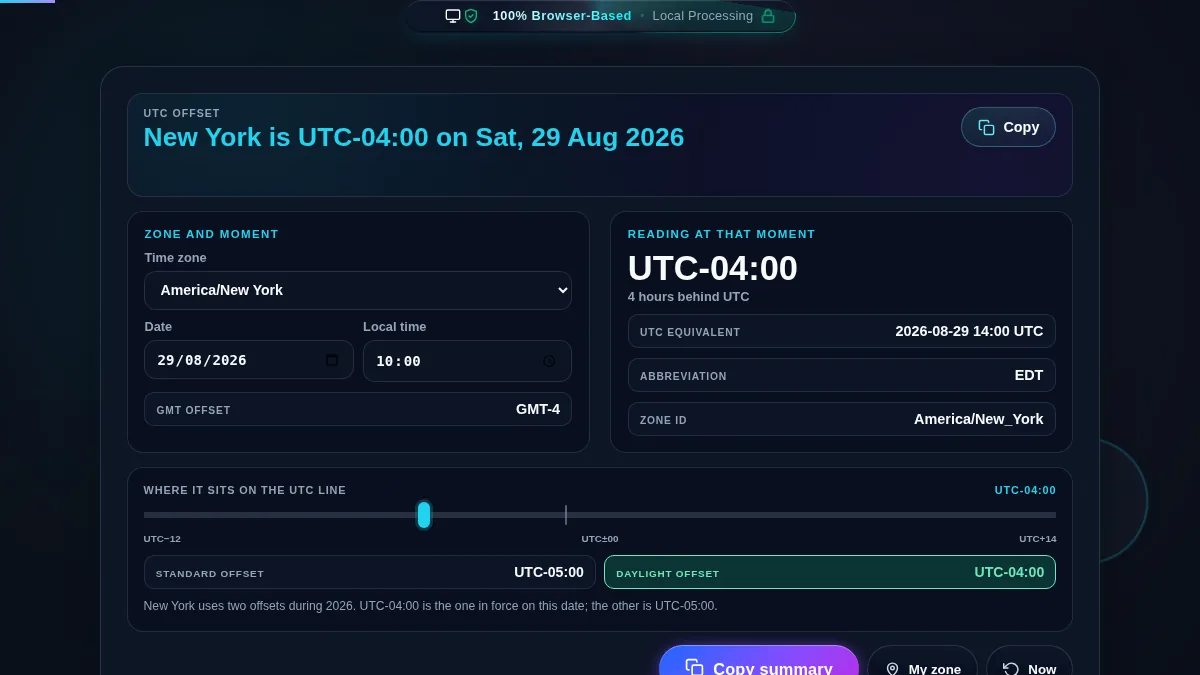
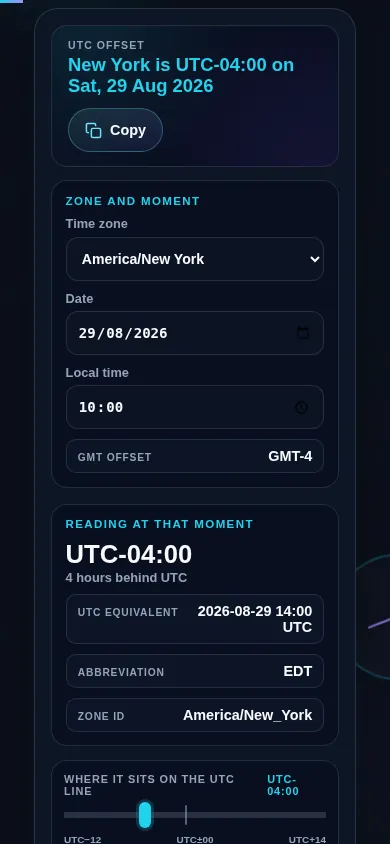
Everything else on the page follows from that one reading: the GMT-style spelling for systems that ask for it, the UTC equivalent of the clock time you typed, the browser's short name for the zone, and the two offsets the zone uses across the year with the one in force marked. To compare two places rather than look one up, use the Time Zone Difference calculator; to find a slot that suits several, the Meeting Time Planner.