Daylight Saving Time Calculator

Both Clock Changes, For Any Zone And Any Year

100% Browser-Based Local Processing
Clock changes
Zone and year
    Zone id
    The year in daylight saving
     
    Standard offset
    Daylight offset
    Clocks move by
    The changes in  

    Every date, offset and count on this page is worked out in your browser from its own time-zone database. The zone and year you choose are never uploaded or stored.

    Privacy Focused

    🔒 Local Processing. The values you enter never leave your device.

    Instant Results

    🌐 Fully Client-Side. Runs instantly in your browser.

    No Signup

    ⚡ No accounts. No API keys. Just open and use.

    Browser Based

    🚀 No installs, no sign-ups, no conversion limits.

    Two Dates, And Everything That Hangs Off Them

    Twice a year a large part of the world moves its clocks, and the countries that do it disagree about when. The European Union changes on the last Sunday in March and the last Sunday in October; the United States changes on the second Sunday in March and the first Sunday in November. That leaves about two weeks each spring and one each autumn when the gap between London and New York is an hour away from the one everybody has memorised, which is where recurring meetings quietly drift and scheduled jobs fire at the wrong time.

    This page gives both dates for whichever zone and year you pick, and it does not stop at the dates. It shows what the local clock reads on each side of the change, both offsets, how far the clocks actually move, how many days of the year sit on daylight saving time, and a bar drawing that period across the twelve months.

    None of it is a rule written into the page. There is no browser API that reports a zone's daylight saving rules, so the year is sampled and each change narrowed down by halving until the exact minute is found. That is why the awkward cases come out right rather than being rounded into "an hour at two in the morning". To ask about one date instead of a whole year, use the DST Checker; to read a zone's offset for a single moment, the Time Zone Offset Finder.
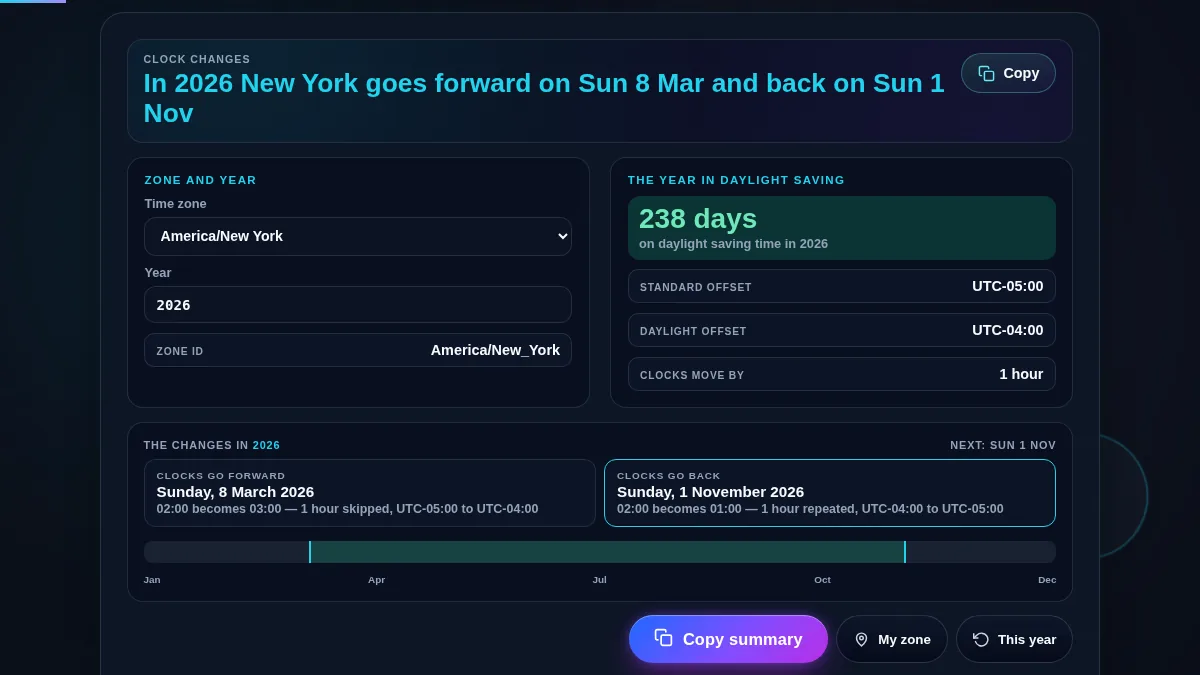
    Full daylight saving time calculator workspace: both clock-change dates across the top, a panel with the zone selector and the year field, a summary panel counting the days on daylight saving with both offsets, and below them the two change blocks and a twelve-month bar with the daylight saving period shaded
    The whole tool on one screen: both dates, what the clocks read on each side, and the period drawn across the year.

    Who Changes When, And Who Does Not

    RegionThe ruleWorth knowing
    European UnionLast Sunday in March, last Sunday in OctoberThe whole union changes at the same instant, 01:00 UTC, rather than at the same local hour
    United States and CanadaSecond Sunday in March, first Sunday in NovemberExtended in 2007, so a year before that has different dates and this page will show them
    Australia and New ZealandForward in late September or early October, back in AprilSouthern summer straddles the new year, so the period on the bar is two spans rather than one
    Lord Howe IslandMoves by thirty minutesThe one-hour assumption is not universal; the page reports the size of the shift it finds
    ChileChanges at midnightThe change belongs to the Sunday even though the clock lands on the Saturday evening
    Most of Asia and Africa, Arizona, HawaiiNo change at allOne offset all year, which the page says plainly instead of showing two empty rows
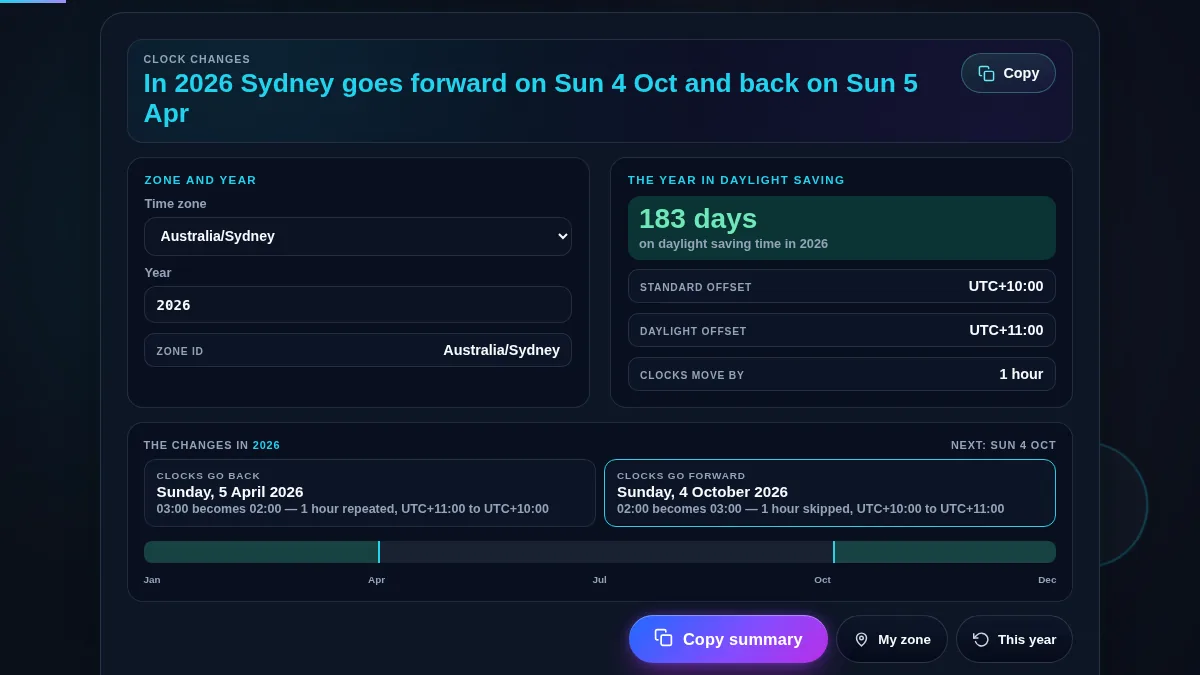
    The daylight saving time calculator set to a southern hemisphere time zone, where the twelve-month bar draws the daylight saving period as two separate shaded spans at the start and the end of the year with standard time in the middle
    South of the equator the period wraps around the new year, so the bar draws two spans rather than one block.

    How to Find the DST Dates

    Four steps from a place and a year to something you can put in a calendar.

    Step 1: Pick the zone

    The selector opens on two dozen zones picked to include the ones that break assumptions — Lord Howe Island, Chatham Island, Santiago, Phoenix — and loads the full IANA list the moment you touch it. My zone jumps to whatever your device reports. A zone id is the right thing to write down: EST belongs to more than one part of the world, and it stops being the correct label the day the clocks move.

    Step 2: Choose the year

    It starts on this year and takes anything from 1900 to 2100. Past years are worth a look when a rule changed: the United States extended daylight saving in 2007, so 2006 and 2007 have different start dates and the page shows the difference if your browser's data reaches back that far. Future years reflect the rules currently on the books, which governments do sometimes amend at short notice.

    Step 3: Read what the clocks actually do

    Each block gives the date, the local time before and after, the size of the move and both offsets, and the next change from today is outlined. Spring forward skips an hour of local time entirely, so a job scheduled inside it either does not run or runs twice; autumn repeats an hour, which is why a local timestamp on that night is genuinely ambiguous and why logs belong in UTC.

    Step 4: Check the bar before you plan around it

    The bar is the year end to end with the daylight saving period shaded and a line at each change. One span means the ordinary northern pattern; two means the period wraps the new year, which is the southern hemisphere and the thing most schedules get wrong about it. Copy summary takes the whole reading as text, each change with its exact instant in ISO 8601, which is the only form that carries no assumption about anybody's local clock.

    Frequently Asked Questions

    When does daylight saving time start and end?

    It depends on the country, and the two halves of the answer are set separately. Pick the zone and the year and the page gives both dates, the local time the clocks read on either side of each change, and the offsets before and after. The dates come out of the browser's own time zone database rather than a rule written into this page, so a year whose rules were later amended still reads correctly.

    Why do the United States and Europe change on different days?

    Because they legislate separately. The European Union moves on the last Sunday in March and the last Sunday in October, at the same instant across the whole union; the United States moves on the second Sunday in March and the first Sunday in November, at 2 AM in each local zone. That leaves roughly two weeks in spring and one in autumn when the usual gap between London and New York is an hour out.

    How many days of the year are on daylight saving time?

    In 2026 it is 238 days in the United States and 210 across the European Union, but the page counts it rather than quoting a figure: it adds up the time between the changes for the zone and year you picked, so a year with different rules gives a different answer. The bar underneath shows the same thing as a span across the twelve months, which makes the southern hemisphere's split period obvious at a glance.

    Why is the daylight saving period split in two on this chart?

    Because in the southern hemisphere summer straddles the new year. Sydney is on daylight saving from the start of January until early April and again from early October to the end of December, so the year begins and ends inside it and the middle is standard time. The bar draws both segments instead of pretending it is one block.

    Do the clocks always move by exactly one hour?

    No. Lord Howe Island moves by thirty minutes, and the page reports the size of the shift rather than assuming. Chatham Island's clocks sit a quarter past the hour on both sides of its change, and Chile changes at midnight rather than at two in the morning, so the local times shown here are read from the data on each side of the transition instead of being written in.

    Can I check a past or a future year?

    Yes, and past years are the more interesting case. The United States extended daylight saving in 2007, so 2006 and 2007 have different start dates, and the page shows the change if your browser's time zone data goes back that far. Future years reflect the rules currently on the books, which governments do sometimes amend at short notice.

    Is my data uploaded or stored anywhere?

    No. Every date, offset and count on this page is worked out in your browser with JavaScript, using the time zone database your operating system already ships. The zone and the year you choose are never sent to Randomly.online, nothing is logged, and there is no account to create.

    Does the daylight saving time calculator work on a phone?

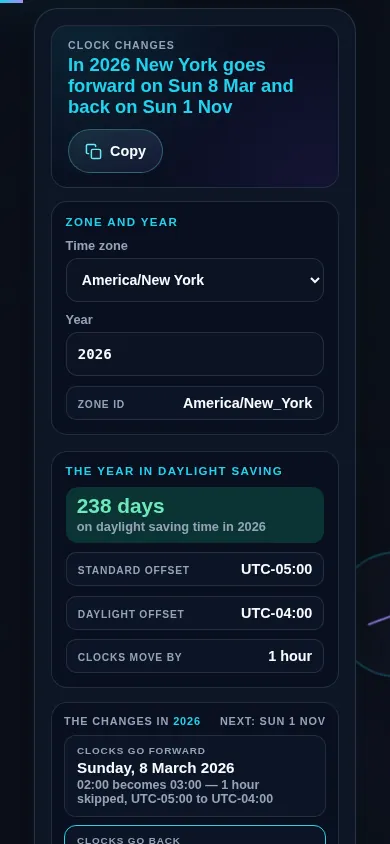
    Yes. On a narrow screen the zone and year controls and the summary panel stack into one column with the answer kept at the top, the two change blocks become full-width, and the year bar keeps its full width with both spans in place. Every control meets a 44px touch target.

    Daylight saving time calculator on a 390px phone: the two clock-change dates written across the top, the zone and year controls stacked in one column, and the summary panel below them counting the days on daylight saving time
    The calculator on a phone — one column, with both dates kept at the top.

    Still have questions?

    If you can't find the answer you're looking for, feel free to contact our support team.

    Contact Us